

Matcha caffeine matters because it sits in a useful middle ground between weak tea and the fast hit many people get from coffee. For people who want focus without a sharp spike, matcha can solve a real daily problem: getting enough stimulation to work, train, or think clearly while keeping jitters and the mid-morning slump in check. The catch is that matcha’s caffeine is often misunderstood, partly because serving size, leaf quality, and preparation change the result more than most buyers expect. A clear view of the numbers and the trade-offs makes it much easier to choose the right matcha and use it well.
What is matcha caffeine and why does it feel different from coffee?
Matcha usually feels steadier than espresso because you consume the whole tea leaf with caffeine and L-theanine together. A typical 1 to 2 gram serving delivers roughly 38 to 88 mg of caffeine, while the amino acid profile can soften the sharp edge many people notice with coffee.
That does not mean matcha is weak. A common misconception is that “it’s just green tea”, so it must be low in caffeine. In practice, matcha is often stronger than a standard brewed green tea because the powdered leaf is whisked into the drink, not steeped and discarded.
The other reason the effect feels different is context. Coffee is often taken quickly, sometimes on an empty stomach. Matcha is usually sipped a little more slowly, often at a lower total caffeine dose. If you drink 1 gram of matcha after breakfast, then compare it with a large filter coffee before food, the experience will not be remotely similar even if both contain caffeine.
How much caffeine is in matcha compared with coffee and green tea?
Matcha commonly sits between brewed green tea and filter coffee. A 1 gram serving may land near 19 to 44 mg, a 2 gram serving near 38 to 88 mg, brewed green tea often around 20 to 45 mg per cup, and a 240 ml coffee around 95 mg.
The range is wide because there is no single “matcha caffeine” number. Dose comes first. If you double the powder, you roughly double the caffeine. Harvest timing, shading, and leaf selection move the figure again.
Side-by-side comparison of caffeine ranges for 1 gram matcha, 2 gram matcha, brewed green tea, and a 240 ml coffee.
Here is the practical comparison. If your usual drink is a double-shot flat white, matcha may or may not contain less caffeine depending on the serving size. If your usual drink is a single cup of black tea, matcha may contain more. This is why teaspoon-based brewing creates confusion. A heaped teaspoon can be much closer to 2 grams than 1 gram.
Pro tip: compare by milligrams per serving you actually drink, not by product category. “Tea” versus “coffee” is too broad to be useful.
What are the best UK matcha options if you want calm, steady caffeine?
The best UK matcha options usually share the same markers: clear origin, shade-grown leaves, no added sugar, and a serving style that lets you control dose. Brands differ in flavour and provenance more than in any guaranteed caffeine promise.
If steady energy is the goal, it makes sense to choose brands that are transparent about where the tea comes from and avoid flavoured café powders loaded with sweeteners. Few matcha brands publish lab-tested caffeine per serving, so sourcing and dose control are your best filters.
- I AM BODHI: Single-origin ceremonial matcha from one family-run farm in Maoshan, Jiangsu, shade-grown and stone-ground, with no additives. It is a strong choice if you want provenance, purity, and a calm daily cup rather than a sweetened blend.
- Clearspring Organic Matcha: Widely available in the UK and useful as a benchmark for an everyday ceremonial-style matcha.
- OMGTea Matcha: A familiar UK name for buyers who want a straightforward entry point and broad retail availability.
- PerfectTed Matcha: Often positioned for convenience and lifestyle use, helpful if portability matters more than strict single-origin focus.
- Marukyu Koyamaen or Ippodo via specialist retailers: Strong reference points for buyers comparing Chinese and Japanese matcha styles on flavour, texture, and price.
The trade-off is simple. If you prioritise single-origin traceability and no additives, you may pay more per tin. If you prioritise price and convenience, you may accept broader blending or less detailed farm-level provenance.
How can you estimate matcha caffeine per serving at home?
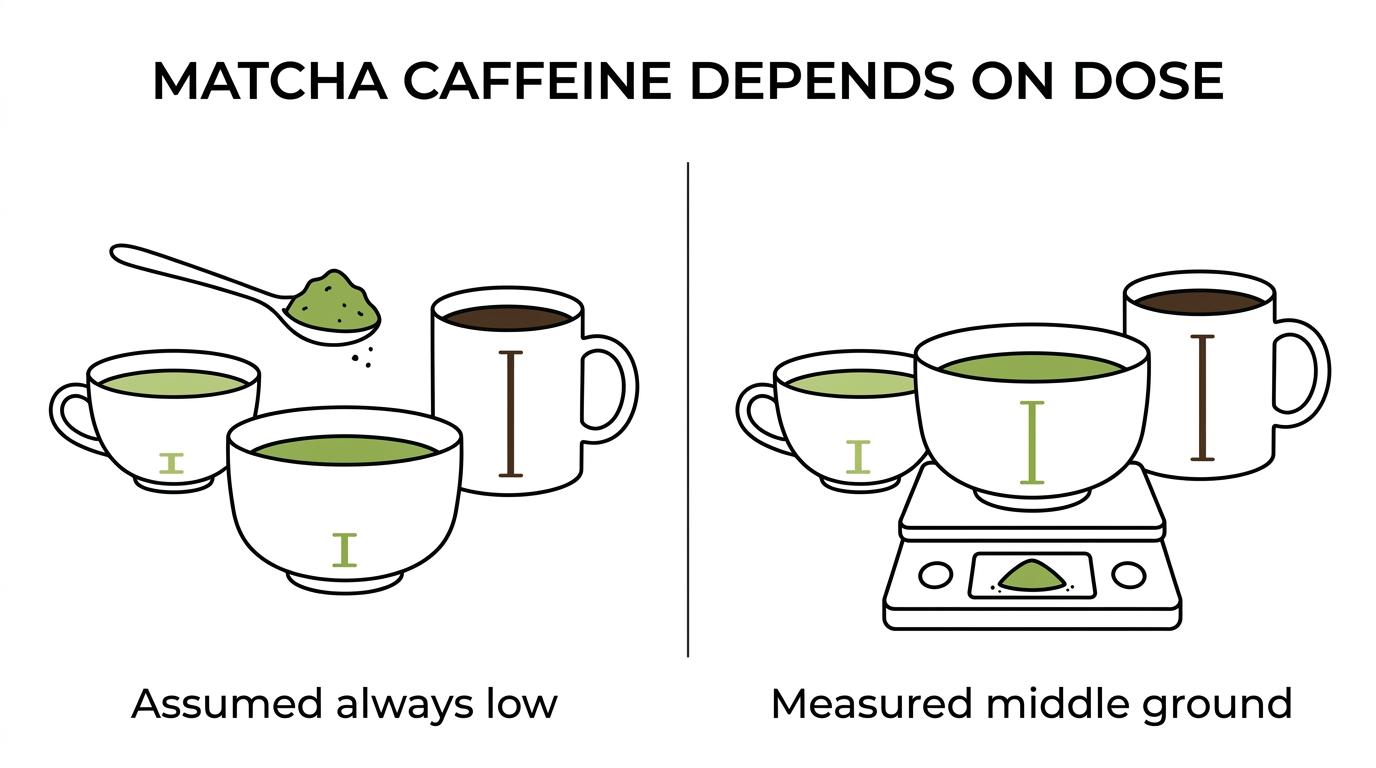
You can estimate matcha caffeine well enough at home by weighing the powder first. Use a digital scale, not a spoon, because 1 gram and 2 grams can feel very different in the body.
Step 1 is to weigh your usual serving. Most home drinks use 1 to 2 grams. Step 2 is to apply a realistic range of about 19 to 44 mg of caffeine per gram. Step 3 is to note how you feel and adjust the next cup by 0.5 gram rather than making big jumps.
If you drink 1 gram, a fair estimate is about 20 to 40 mg. If you drink 1.5 grams, expect about 30 to 65 mg. If you drink 2 grams, you are often in the 40 to 90 mg range. That is not a lab result, but it is accurate enough for daily planning.
Pro tip: a level chashaku scoop and a kitchen teaspoon are not interchangeable. Spoon size is one of the biggest reasons people think matcha is unpredictable.
How should you prepare matcha if you want less caffeine in the cup?
Use less powder, not colder water, if you want meaningfully less caffeine. With matcha, dose matters more than extraction because the leaf stays in the bowl or glass.
Step 1 is to cut serving size to 0.5 to 1 gram. Step 2 is to whisk with 60 to 80 ml of water at about 70 to 80°C for a lighter usucha-style cup. Step 3 is to add more water or milk after whisking if you want volume without raising caffeine.
A common misconception is that cooler water “removes” most of the caffeine issue. That logic works better with steeped tea than with powdered tea. If the powder is still in the drink, you are still consuming the caffeine it contains.
There is a trade-off. Lowering the dose reduces stimulation, though it can also improve sweetness and reduce astringency if a matcha tastes too intense for you. For many people, 1 gram is the sweet spot for a calm morning.
When should you drink matcha caffeine for focus without hurting sleep?
Morning to early afternoon is the safest window for most adults. Caffeine’s half-life averages about five hours, so a 3 pm serving can still be active at 8 pm, especially if you are sensitive.
Step 1 is to anchor bedtime. If you aim to sleep at 11 pm, count back at least 8 hours, and preferably 10 if sleep is fragile. Step 2 is to test matcha after breakfast or just before lunch. Step 3 is to track sleep for a week before moving the timing later.
If you are switching from coffee, matcha can work well around the late-morning dip because the dose is easy to control. If you train in the afternoon, a smaller serving, around 0.5 to 1 gram, may give enough lift without pushing into the evening.
Pro tip: energy timing is not only about caffeine. Food, hydration, and stress load change how stimulating the same bowl feels.
Matcha vs coffee for caffeine: which gives steadier energy?
Matcha often gives steadier energy for people who dislike the sharpness of coffee, while coffee usually gives a stronger, faster lift. Matcha and filter coffee can overlap on caffeine, but the subjective feel often differs because matcha brings L-theanine and is commonly consumed in smaller doses.
If you need immediate stimulation before an early meeting or a long drive, coffee may feel more decisive. If you want three focused hours of desk work without feeling over-revved, matcha is often easier to fine-tune.
The trade-off is speed versus control. Coffee is efficient and consistent when ordered out, especially from chains like Starbucks or Pret where cup size is familiar. Matcha offers more control at home because half a gram makes a noticeable difference. If you are prone to jitters, that control matters.
A common misconception is that matcha “has no crash”. Any caffeine can produce a rebound if total intake is high, sleep is poor, or you drink it on an empty stomach. Matcha may reduce the spike for some people, but it is still a caffeinated product.
Why do shade-grown leaves and harvest timing change matcha caffeine?
Shade-growing and young spring leaves often raise the caffeine potential of matcha. Gyokuro and high-grade matcha share this principle: shading shifts leaf chemistry, and younger leaves are usually more prized for both sweetness and stimulant profile.
Before harvest, tea plants for matcha are shaded for days or weeks, depending on the producer’s method. That tends to preserve amino acids including L-theanine and can support higher caffeine in the leaf. First-harvest material is also generally finer and sweeter than later-season leaf.
This does not mean the brightest green powder always has the most caffeine. Common misconception: colour alone tells you the stimulant level. It does not. Colour speaks to chlorophyll, freshness, and processing quality, but caffeine still depends on cultivar, shading depth, leaf age, and serving size.
For buyers, the practical link is simple. If a matcha is single-origin, shade-grown, spring-harvest, and stone-ground, you are usually looking at a product built for flavour quality and a fuller matcha experience, not just colour.
Does L-theanine change how matcha caffeine feels in the body?
Yes, L-theanine can change the feel of caffeine, and matcha is one of the best-known natural sources. Research on caffeine and L-theanine suggests the pairing may support alertness and attention with less perceived mental noise than caffeine alone in some people.
That does not make matcha sedating. It still contains caffeine, and dose still rules. If you drink 3 grams quickly on an empty stomach, you may still feel overstimulated. If you drink 1 gram after food, the same tea may feel clean and steady.
This is why people often describe matcha as “calm energy”. The phrase is useful, though it can be over-romanticised. The better way to read it is that matcha may feel less jagged than coffee for some drinkers, not that it overrides basic caffeine physiology.
How much matcha caffeine is sensible in a day for most adults?
For most healthy adults, total caffeine matters more than the source. EFSA has said up to 400 mg of caffeine per day is generally safe for most adults, with single doses up to 200 mg posing no safety concern for most people.
That does not mean 400 mg is the right personal target. Many people feel best much lower, especially if they are smaller, anxious, or already sleep lightly. If your matcha habit sits around 1 to 2 bowls a day at 1 gram each, you are often well below that ceiling.
Use if-then logic here. If you also drink coffee, pre-workout, cola, or energy drinks, add everything together. If your total creeps past 200 to 300 mg and you notice palpitations, irritability, or broken sleep, reduce the strongest source first.
In pregnancy, the NHS advises keeping caffeine to 200 mg a day or less. That is where weighing matcha becomes especially useful.
Who should be more careful with matcha caffeine?
Pregnant people, caffeine-sensitive adults, and anyone with anxiety, arrhythmia, or stimulant medication use should be more careful. NHS and EFSA guidance gives a good baseline, though personal tolerance still varies.
Matcha is not automatically gentler just because it is tea. If you know caffeine affects you strongly, start low and treat matcha with the same respect you would give coffee. A small serving is often enough.
- If you are pregnant: keep total daily caffeine within NHS guidance and count all sources, not only matcha.
- If you are anxiety-prone: start at 0.5 to 1 gram, take it with food, and avoid stacking it with coffee.
- If you have heart palpitations or take stimulants: ask a clinician before adding regular matcha.
- If sleep is light: keep matcha to the morning and review the full caffeine picture, including chocolate and soft drinks.
One final practical point matters for tea drinkers who use matcha daily. Tannins and polyphenols can affect iron absorption around meals in some people. If iron status is a concern, keep caffeinated drinks away from iron-rich meals and follow medical advice.